


What you need to know: Spend under management is the share of addressable third-party spend that runs through a governed procurement process. This is spend that went through an approved request or sourcing process, sits under a negotiated contract, and has an owner. The math is easy. The data is the hard part, because the figure pulls from suppliers, contracts, renewals, and invoices that usually sit in different systems. Teams can raise the percentage of spend under management by consolidating those inputs into one supplier record, giving stakeholders a request path they actually use, and reporting from live workflow data.
What Counts as Spend Under Management
Spend under management is governed third-party spend divided by total addressable third-party spend. What does that mean?
- Governed: the spend went through an approved request or sourcing process, sits under a negotiated contract, and has an owner.
- Addressable: spend that procurement can influence, which excludes taxes, payroll, and regulated fees.
Employee spend also stays outside the calculation. Travel, corporate cards, and meals are real money leaving the company, so it is fair to wonder why they are not under the spend management umbrella.
Spend management and expense management sit at opposite ends of a purchase. Spend management governs supplier commitments before they exist: what you buy, from whom, and on what terms. Expense management reconciles what employees already spent. A card program can report last month's employee spend in full detail but not move your spend under management figure at all.
How to Track Spend Under Management Accurately
Accurate tracking depends less on the reporting tool than on the data feeding it. The quality of the figure comes down to how cleanly your supplier, contract, and spend records line up with each other.
Four inputs produce an accurate spend under management number:
- A deduplicated supplier list: This ensures that the same vendor with three different spellings only counts once.
- Spend joined to suppliers and contracts: This allows your team to see which dollars sit under negotiated terms.
- A defined request path: New spend is categorized as it enters rather than reconstructed later.
- Reporting drawn from live workflow data: Numbers are current no matter when someone asks.
The ability to pull from live workflow data is the biggest change. Spend under management has traditionally been rebuilt once a quarter from exports, so the figure presented in a review describes a quarter that has already closed. When supplier, contract, and spend data sit in one system, the number updates as work happens, and it becomes something to use proactively rather than report on.
Other metrics help to fill in the picture: contract coverage, cycle time, early engagement (requests that arrive before a supplier has been selected), renewal visibility, and duplicate suppliers consolidated.
Four Maturity Stages of Spend Under Management
Teams tend to move through four stages of spend under management maturity. To identify your team’s stage, ask how long it would take to answer one question: what did we spend with our top 20 suppliers last quarter, and how much of it sat under contract? The time it takes to answer says more than the percentage does:
- Reconstructed: Answering takes a week of exports and reconciliation, so the spend under management number is estimated rather than measured.
- Reported: Answering takes a day. Suppliers are deduplicated and joined to contracts, and the number holds up in a quarterly review.
- Governed: Answering takes an hour. A defined intake path categorizes new spend as it arrives, so the figure reflects current commitments.
- Live: Answering takes a minute from a dashboard anyone can open, and uncovered spend surfaces while purchases are still in motion.
Moving from one stage to the next also moves the conversation earlier, from reporting on commitments already made to shaping the ones still in front of you.
Increasing Spend Under Management
Increasing the amount of spend under management comes down to making the governed path the easiest one for a stakeholder to take. The Hackett Group's 2026 Procurement Key Issues research reports an 8% workload increase amid declining headcount and operating budgets, so the practices that scale are the ones that remove work rather than redistribute it.
- Give stakeholders one obvious entry point. Every governed dollar starts with a request that made it to procurement. One clear system keeps requests from scattering across inboxes.
- Route on risk and value, not dollar amount alone. A single threshold treats a $60,000 tool that touches no customer data the same as a $60,000 vendor with access to employee records.
- Build one supplier record, and have everything reference it. Unifying suppliers, contracts, spend, and risk turns duplicate-supplier questions and category totals into answers rather than projects.
- Surface renewals early enough to act on them. A renewal found 30 days out is largely a price acceptance. The same renewal surfaced at 120 days is an opportunity for a sourcing event with alternatives.
- Report cycle time and early engagement. Both metrics are harder to dispute than savings figures, and they point at the next bottleneck worth fixing.
How Levelpath Helps Grow Spend Under Management
Three things keep the percentage of spend under management low: procurement learns about purchases too late to influence them, supplier and contract data sits in separate systems, and reporting has to be rebuilt by hand. Levelpath’s AI-native procurement platform works on all three.
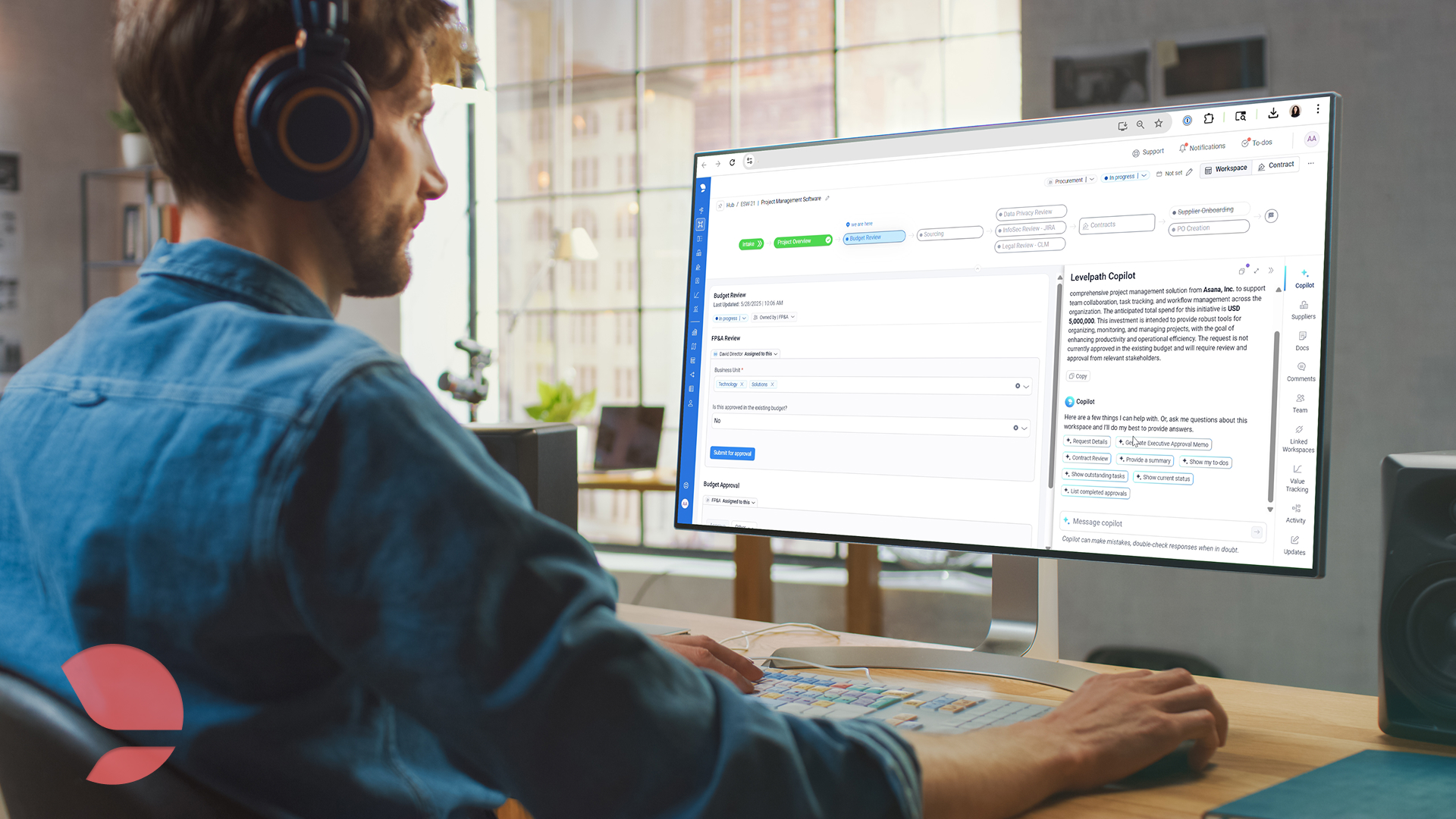
Spend is captured before it is committed. Stakeholders make requests in plain language from a mobile app, Slack, or Teams, and Levelpath applies the right workflow, approvals, and policy automatically. Requests that would have routed around procurement land inside the process instead, which moves spend into the governed column.
Supplier, contract, and spend data live in one record. Levelpath's supplier graph unifies suppliers, contracts, spend history, and risk into one dynamic system of record, connected to the ERP and contract systems you already run. Duplicate suppliers are surfaced and contract spend is calculable.
The number stays current without an analyst. Ask what you are spending, with whom, and under what terms, and Levelpath answers from live workflow data, with charts and the underlying records a click away. Procurement, finance, and leadership see the same number in real time.
AI Agents handle the work that crowds out category strategy: drafting RFPs, scoring supplier responses, reviewing contracts, tracking obligations, and flagging renewals. Levelpath's AI Agents are built natively into the platform rather than added to individual modules, so they work from the right context every time.
Increasing spend under management does not require a program that touches every category at once. Pick the workflow where spend visibility is often late, make that path faster than the workaround, and connect the supplier and contract data behind it.
Request a demo to see how Levelpath brings spend into view across intake, sourcing, and supplier management.


.jpg)