


Your CEO just asked for your AI plan. Your CFO wants to know what procurement is doing with AI. The board brought it up at the last meeting.
If you are a CPO, questions about AI are landing on your desk right now. The pressure is real, and the data paints a clear picture: BCG's AI at Work 2025 survey found that more than three-quarters of leaders and managers are using GenAI several times a week, but frontline employee adoption has stalled at just 51%. Only one-third of employees say they have been properly trained. The tools are there, but the skills are not. That gap is where the real opportunity sits.
The good news: this is the right moment to build your plan. A year ago, the technology was not as advanced; new models and capabilities have been released even in the last six months. Right now, the space is defined enough to act on, and it is still early enough for teams to get ahead.
The AI playbook has been written for nearly every other function. IT has deployed copilots. Sales has automated pipeline scoring. Customer success is running AI-powered onboarding. Here is the 3 pillar AI procurement playbook.
Procurement’s AI Playbook
Most procurement teams start their AI journey with a tool. The ones that scale successfully do three things differently: they invest in skills, they build the operational muscle to manage AI Agents, and they measure progress in a way leadership can see.
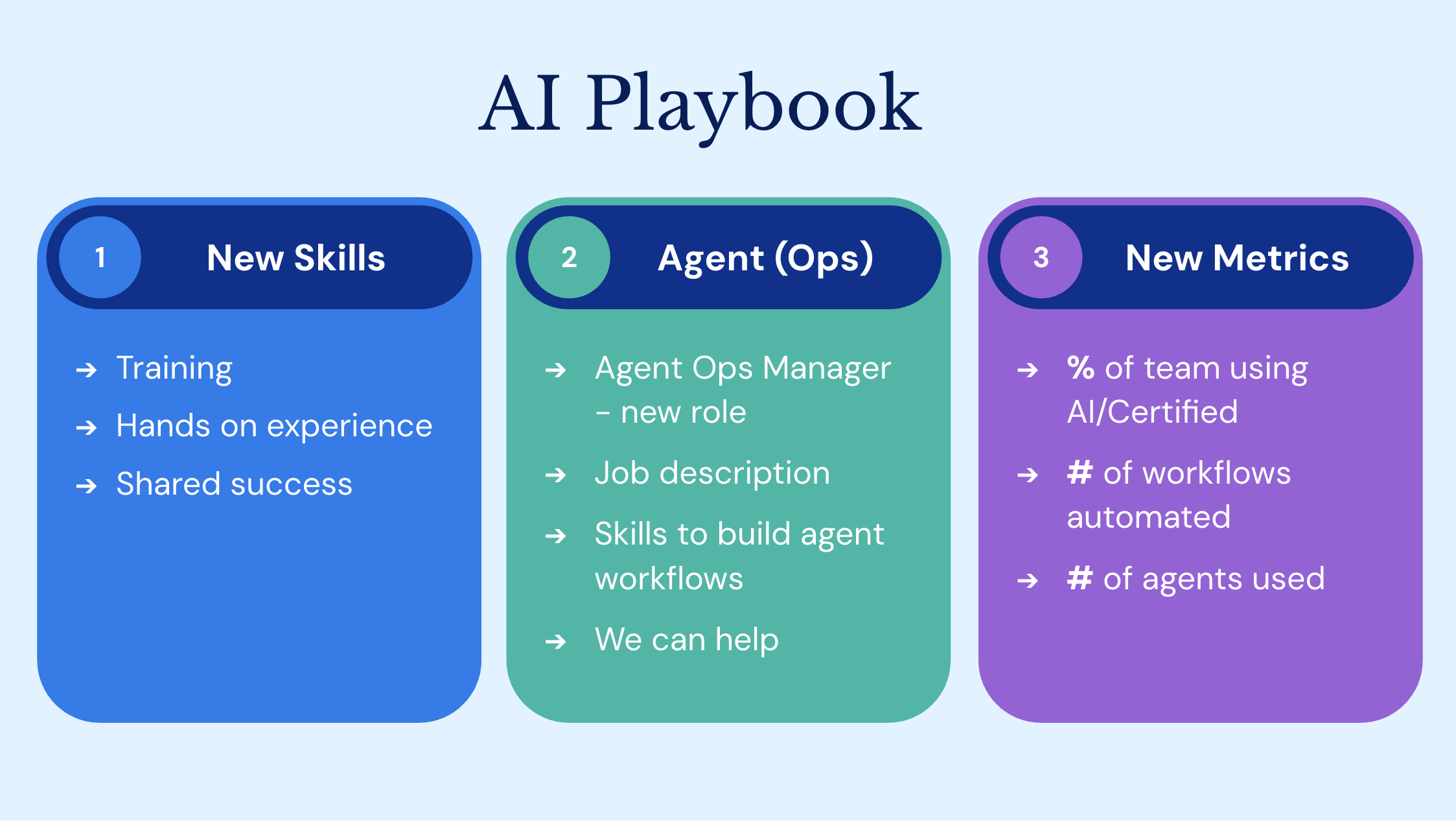
Pillar 1: New Skills
The first goal should be to get your current team using AI every day. This sounds obvious, but it's not happening at most organizations.
Most procurement professionals are curious about AI. The real barrier is access and comfort. Many teams don't have approved tools. Those who do may lack the prompt literacy to get real value from them. These steps build a structured upskilling foundation:
- Training.
Get formal about it. Run a short internal workshop on AI fundamentals for procurement: what the tools can do, what they can't, and where they fit into existing workflows. You don't need a week-long certification program.
A 90-minute session that gets everyone on the same page is enough to start. If you don't have internal expertise, bring someone in. There is no shortage of AI training right now, from conference sessions to online university courses to vendor-led enablement.
- Hands-on experience.
Training without hands-on practice doesn’t lead to high adoption. Give every team member an approved AI tool and a specific assignment: use it for one real task this week. Draft an RFP section. Summarize a supplier proposal. Build a comparison matrix.
The tool matters less than the habit. Once someone gets a genuinely useful result from AI on a real work problem, the adoption curve shifts from skepticism to curiosity.
- Shared success.
Make AI wins visible. When someone on your team uses AI to cut a process from four hours to forty minutes, that story should be told in your next team meeting. Create a shared channel where people post their prompts, their results, and their lessons learned.
This does two things: it gives your less confident team members concrete examples to follow, and it creates a growing library of procurement-specific use cases that are more valuable than any generic "100 AI prompts" list.
When your CEO asks, "What is the team doing about AI?", you want to answer with specifics: "We have trained the full team, X% are using AI tools weekly, and here are three real examples of where it has already saved us time." That is a credible answer that builds trust.
Pillar 2: Agent Ops
Many procurement teams have a systems person called Procurement Ops. This person keeps the tech stack running, manages integrations, and configures workflows. They are in need of a new counterpart: Agent Ops.
Procurement Ops configures a system so that when a user clicks a button, the right form appears. Agent Ops designs, builds, and monitors AI Agents that handle entire process steps on their own: reviewing contracts against playbooks, scoring supplier responses, routing approvals, and flagging renewal deadlines.
Building agents is not the same as configuring software. It requires understanding what decisions can be automated versus what needs human judgment, how to set guardrails, how to measure whether an agent is performing well, and how to improve it over time.
Your Agent Ops action plan
- Hire Agent Ops or uplevel your ProcurementOps role.
There are two options for this. If you already have a ProcurementOps person who is building automations, testing new tools, and asking "what if we automated this?" then that's your Agent Ops candidate. Give them the mandate, the time, and the resources to expand into agent design and management. If no one on your team fits that profile, this is a new hire worth prioritizing.
- Write the job description.
Whether this is a new role or an expanded one, document it. The Agent Ops Manager sits at the intersection of three skill sets: procurement domain knowledge, technical fluency with AI and automation platforms, and process design. That combination is rare, which is exactly why formalizing it matters. Levelpath has a sample job description to help you get started.
- Build the skills to create agent workflows.
This role needs to learn how to design agent workflows, not just use AI tools. That means understanding how to break a procurement process into automatable steps, how to define the inputs and outputs for each agent, and how to set up the guardrails that keep automated decisions reliable.
- Start building.
Pick one high-volume, low-complexity process and automate it. Contract review against standard terms. Supplier qualification screening. Purchase request triage. Your first IA Agent does not need to be sophisticated. It needs to have real, provable outcomes. That first win funds everything that comes after.
Without a dedicated Agent Ops function, AI Agents become one-off experiments that nobody maintains. The contract review bot that someone built in Q1 is forgotten by Q3. The sourcing agent that seemed promising never gets the data access it needs to work properly.
Agent Ops is the operational backbone that turns experiments into infrastructure. This person owns the roadmap, manages the lifecycle, and keeps every automated workflow reliable.
Pillar 3: New Metrics
You cannot run a playbook without a scoreboard. Measuring results is crucial.
McKinsey's recent analysis of procurement in the agentic AI era argues that "successful transformations pair technology with operating model redesign, new KPIs, and strong change leadership." They propose that procurement teams move toward measuring "procurement ROI" as a single composite metric: total value created divided by the total cost to achieve it. The right KPIs here are deliberately simple.
Your new AI scoreboard
- Percentage of the team using AI.
You have a team of 10, 30, or even 50 people. How many of them are using AI in their daily work? Not once a quarter for a demo. Regularly. For email drafting, contract review, supplier research, data analysis, and meeting prep.
Consider building a lightweight internal AI certification: a short skills assessment that confirms team members can use AI tools effectively for common procurement tasks. If only two people on a thirty-person team are using AI, you have an adoption problem.
How to track it: Check usage data from your AI tools. Set a target: 50% of the team actively using AI within 90 days, 80% within six months.
- Number of workflows automated.
Count the specific processes where AI has replaced manual steps. Contract redline reviews. Supplier qualification screenings. Spend categorization. This metric tells you whether Agent Ops is producing results. Each automated workflow is a compounding investment: it saves time every single time it runs.
How to track it: For each automated workflow, document what it does, when it went live, and an estimate of the time saved per instance. This becomes your ROI story.
- Number of active AI agents.
This is the most forward-looking metric. How many AI Agents are live, running, and handling real work? Start small: a contract review agent that flags non-standard terms, a sourcing agent that scores supplier responses against your criteria. Then build toward end-to-end workflows where multiple agents handle a complete process from intake to completion.
How to track it: Count AI Agents that have executed at least one task in the past 30 days. An agent that was built but never used does not count.
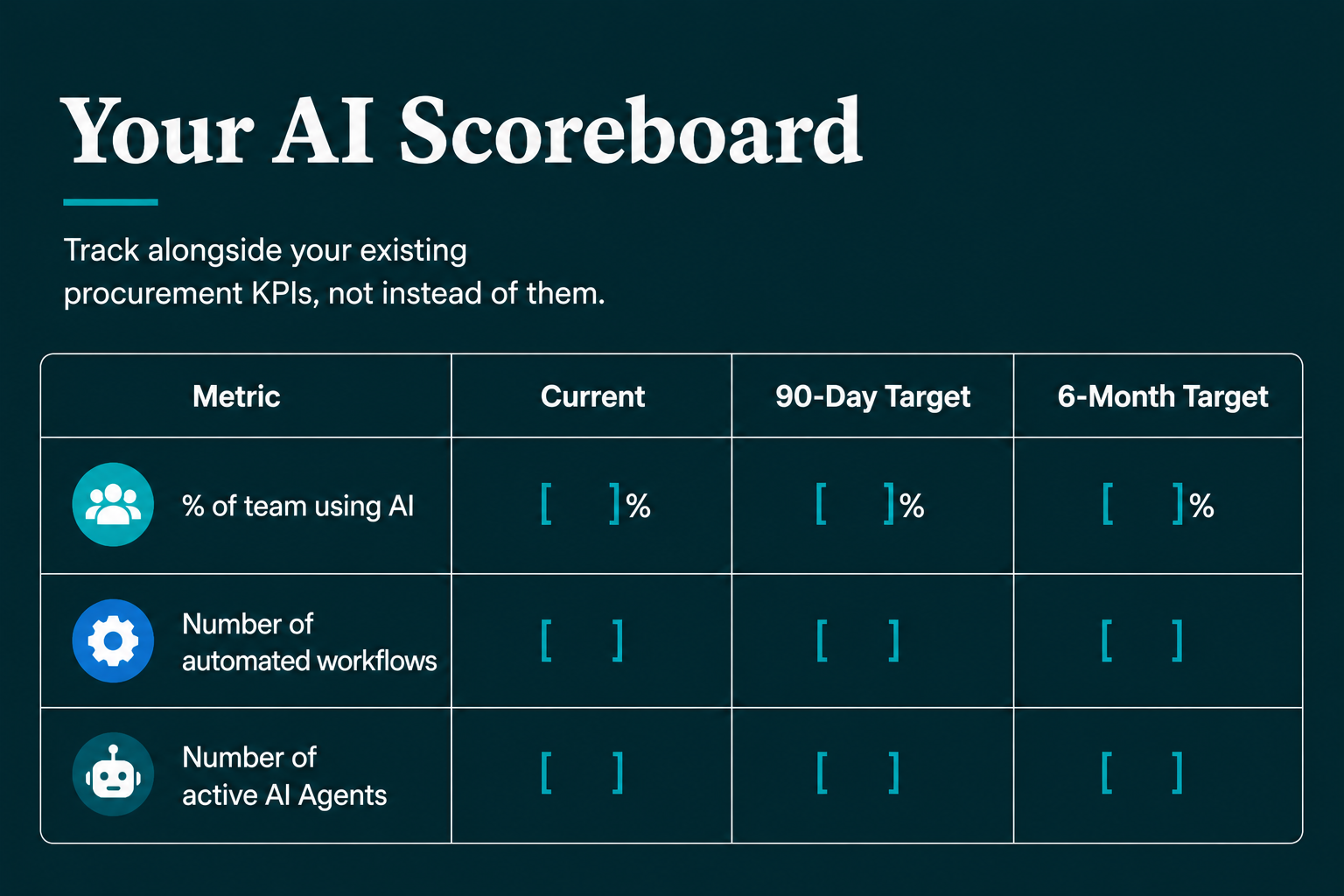
These new KPIs sit alongside traditional procurement metrics. Savings, spend under management, cycle times, and compliance rates are not going away. The new metrics serve a different purpose. They demonstrate to leadership that your team is building AI capability.
Start now, not next quarter
Now that you have an AI playbook, the hard part becomes getting it off the ground. The companies that will separate themselves over the next year are not necessarily the ones with the biggest AI budgets. They are the ones that treat AI adoption as an operational discipline: structured upskilling, a dedicated function to build and manage agents, and KPIs that create accountability from the executive level down.
The good news is these three areas feed each other naturally. A team that's comfortable with AI tools starts spotting opportunities for automation. More automation means more data to measure. Better metrics mean a stronger case for leadership to keep investing. The sooner you start, the faster the results compound.
How Levelpath Can Help
A playbook only works if you have the infrastructure to run it. Unfortunately, many procurement platforms bolted AI on as an afterthought, which means your team ends up stitching together tools that don't talk to each other.
Levelpath is AI-native, which means AI Agents are woven into every step of the procurement process. They work with the same context your team does, so their output is relevant from day one. Sourcing Agents kickstart RFP drafts, score responses, and analyze supplier pricing. Contracts Agents author first drafts, review and summarize terms, route approvals, track obligations, and flag renewals. Supplier Management Agents score risk, flag compliance gaps, and uncover duplicate suppliers.
You can use pre-built AI Agents from the library or create your own in minutes with no code needed. The platform is deployable in days, not months, which means your team can start building real AI fluency right away instead of waiting on a six-month implementation. And because Levelpath serves as your system of record, every agent action, automated workflow, and adoption metric is tracked in one place.
Book a demo to see it in action.