.png)



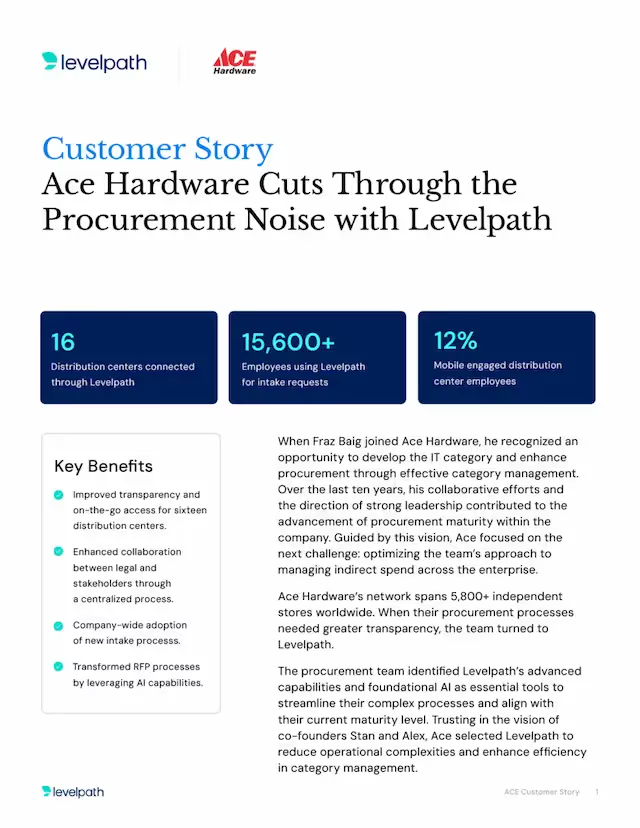
When Fraz Baig joined Ace Hardware, he recognized an opportunity to develop the IT category and enhance procurement through effective category management. Over the last ten years, his collaborative efforts and the direction of strong leadership contributed to the advancement of procurement maturity within the company. Guided by this vision, Ace focused on the next challenge: optimizing the team’s approach to managing indirect spend across the enterprise.
Ace Hardware’s network spans 5,800+ independent stores worldwide. When their procurement processes needed greater transparency, the team turned to Levelpath.
The procurement team identified Levelpath’s advanced capabilities and foundational AI as essential tools to streamline their complex processes and align with their current maturity level. Trusting in the vision of co-founders Stan and Alex, Ace selected Levelpath to reduce operational complexities and enhance efficiency in category management.
The Challenges
Ace Hardware recognized several opportunities to leverage Levelpath’s technology to better define processes and streamline operations across multiple teams.
Connecting Distribution Centers
With 16 distribution centers supporting their capital expenditure sourcing activities, Ace Hardware faced challenges in fostering effective relationships with these critical hubs.
While procurement had built relationships with marketing, supply chain, and retail, the same level of engagement was missing with their distribution centers. “It was clear stakeholders were uncertain when to engage with procurement, what the procurement process was during the sourcing activities, why some processes took so long, or where to get help to drive the processes,” explained Baig.
Procurement needed to give the distribution centers the transparency they needed to see updates and understand where things were within the sourcing process.
To address these issues, the procurement team needed to provide the distribution centers with the necessary transparency to monitor updates and understand the status of various sourcing processes.
Streamlining Legal Partnerships
When Ace Hardware’s facility managers needed to establish new supplier relationships or vendor contracts, they faced a significant disconnect with their Legal department. The problem? The facility managers and the attorneys couldn’t be further apart in terms of their day-to-day lives. The two teams operated in completely different worlds, making it challenging to create contracts that effectively served everyone’s needs.
Beyond this communication gap, Ace Hardware lacked a standardized contracting process that could adapt to their diverse supplier relationships. Ace needed a way to build out those standards and templates so the facility managers could make sure they were buying from a supplier for the right price.
Transforming Supplier Intelligence
With over 60,000 vendors in their global database, Ace Hardware’s supplier management system was complex and fragmented. While they had legacy systems that housed that supplier data after each step of their onboarding process, Baig saw an opportunity to make that data work for the business.
“Many solutions can simply warehouse data,” explains Baig. “Our vision was to make that data truly actionable. We weren’t looking for another lookup tool, procurement needs data that drives meaningful actions.”
There was a desire to connect Ace’s existing technology stack with a solution that would eliminate data silos, enable data capture, and connect that information so the business could have better conversations about supplier management, and determine preferred suppliers. This would transform static supplier data into a dynamic business asset.
Bringing Processes to the Forefront with Levelpath
Baig was first introduced to Levelpath through his relationship with the company’s founders. Having recognized their enthusiasm for the solution and the difference it could make for procurement professionals, Baig explored the possibilities Levelpath created for Ace.
“While we had robust systems in place, we needed something to seamlessly integrate everything together,” explains Baig. “What sets Levelpath apart isn’t just their technology, it’s their collaborative approach to development. They truly partner with their customers, incorporating real-world feedback to shape their solution. The combination of their people, technology, and vision aligned perfectly with what Ace needed.”
Recognizing that Ace could integrate Levelpath into their existing tech stack and offer an easy-to-use interface, Baig knew this was the right tool for his team. Almost immediately, they saw positive changes.
Levelpath’s enablement of AI and the Hyperbridge layer was really a differentiator for Ace.
Fraz Baig, Director of Category Management and Operations
Ace Hardware
Streamlined Distribution Center Operations
From day one, Levelpath revolutionized how Ace Hardware communicates with their distribution centers. The platform introduced visibility across the procurement process, empowering facility managers with real-time insights and control.
“Facility managers now have a centralized platform where they can manage projects, submit vendor requests to the indirect procurement team, and track progress in real-time,” notes Baig. “We’ve improved our supplier setup workflow and strengthened our collaboration with Legal. The platform connects all our work streams, giving us clear visibility into processes that used to be black boxes. This transparency drives meaningful conversations about optimizing our operations.”
These process improvements also allowed for much more efficient management of incoming requests. The impact has been transformative for Ace’s operational efficiency. By consolidating stakeholder interactions within Levelpath, what once required extensive coordination can now be managed effectively by just two team members. This streamlined approach has significantly accelerated vendor relationships and reduced administrative overhead.
Levelpath has become a central portal for Ace as it relates to working with our distribution folks and making procurement easier for them.
Fraz Baig, Director of Category Management and Operations
Ace Hardware
Enabled Focus on Key Suppliers
With Levelpath’s Hyperbridge reasoning engine, Ace Hardware simplified their supplier landscape by identifying 40% of secondary suppliers that were providing overlapping services. This data-driven optimization allowed them to view their supplier network with a new focus.
“By analyzing our supplier data through Levelpath, we could make strategic decisions about which vendors belonged in our indirect procurement ecosystem,” explains Baig. “This systematic evaluation led to a significant refinement of our original supplier list, helping us focus our resources where they matter most,” claimed Baig.
Ace streamlined their supplier database and can now look at those preferred suppliers and explore how the procurement team has historically worked with them and easily evaluate where to make changes to get the best benefits. “We’re taking a targeted approach, focusing on key vendors within critical categories,” Baig notes. “By examining three strategic partners in each of our five most crucial categories, we can test, learn, and adapt our approach based on vendor responses.”
The enriched supplier data has elevated Ace’s procurement capabilities to new heights. “Our team has matured to the point where we’re managing Ace’s most strategic initiatives. Now, we’re focusing on optimizing our spending to maximize our impact across these initiatives. Honestly, without Levelpath’s supplier enrichment process, there are many suppliers we wouldn’t even fully understand what they offer.”
AI-Powered Procurement Innovation
Ace has further amplified their procurement efficiency by leveraging Levelpath’s AI capabilities, particularly the Sourcing feature, to accelerate supplier evaluation and pricing decisions. “Our RFP process has been transformed,” says Baig. “We are not just making better decisions about current supplier selection, we are gaining deeper insights into market dynamics that inform our strategic planning.”
Beyond the AI Buzzword
“AI may be a buzzword in the industry, but Levelpath’s approach is fundamentally different,” Baig emphasizes. “They’re building on AI’s foundation with purpose, creating practical tools that deliver real results. The proof isn’t in the promise, it’s in the daily value we see from using this platform.”
Ace Hardware sees their collaboration with Levelpath as central to their strategic vision. “Levelpath has become our cornerstone for stakeholder transparency and visibility,” Baig reflects. “By centralizing our operations within their platform, we’re not just solving today’s challenges, we’re building the framework for tomorrow’s success.”
His final thoughts?
“While procurement has diverse responsibilities, Levelpath streamlines our processes and filters out the daily operational noise. Levelpath allows us to focus on what truly matters – driving the business forward.”